
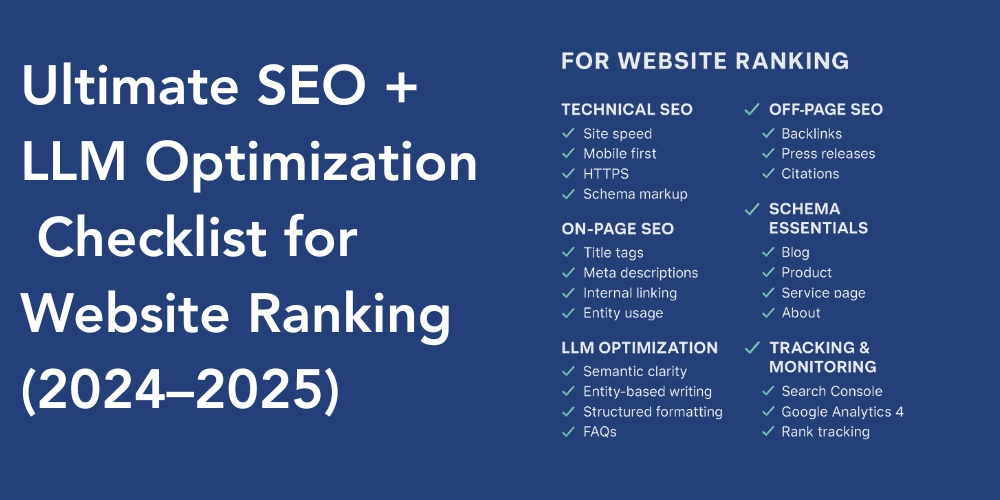
If you’re serious about ranking higher in Google and making your website AI-optimized for the future, this SEO + LLM (Language Learning Model) checklist covers everything you need — from technical setup to content formatting, schema, and more.
🔹 1. Technical SEO (Foundation)
| Area | Task |
|---|---|
| Site Speed | Optimize Core Web Vitals (PageSpeed Insights, lazy load, compress CSS/JS/images) |
| Mobile First | Responsive design, pass Google’s Mobile-Friendly Test |
| HTTPS | Secure with SSL |
| Indexing | Submit sitemap.xml via Google Search Console |
| Robots.txt | Disallow unimportant URLs, allow crawlable assets |
| Crawl Depth | Ensure important pages are max 3 clicks from homepage |
| Canonicals | Avoid duplicate content with proper canonical tags |
| Schema Markup | Add JSON-LD for Articles, FAQs, Reviews, etc. |
| Broken Links | Fix 404s using Ahrefs or Screaming Frog |
🔹 2. On-Page SEO
| Element | Best Practice |
| Title Tags | Start with primary keyword; keep < 60 characters |
| Meta Descriptions | Include primary keyword + CTA; < 160 characters |
| H1-H3 Tags | One H1 per page; use H2-H3 for structure |
| URL Slugs | Short, keyword-rich, and clean |
| Content Length | 800–2,500+ words depending on topic |
| Internal Linking | 2–5 contextual links per page |
| Entity Usage | Mention brands, people, tools, locations |
| NLP-Friendly | Use synonyms and semantically related terms |
| Alt Text | Use descriptive, keyword-rich image ALT tags |
🔹 3. LLM Optimization (AI-Ready Content)
| Feature | Action |
| Semantic Clarity | Short sentences, active voice, structured paragraphs |
| Contextual Anchors | Link entities instead of just keywords |
| JSON-LD Schema | Article, FAQ, Breadcrumb, Product, Person |
| Entity Writing | Use known terms, brands, and semantic cues |
| Structured Formatting | Use lists, tables, headings, bold for clarity |
| AI-Crawl Friendly | Make paragraphs understandable in isolation |
| Source Attribution | Link to trusted sources with factual claims |
| FAQs | Add 3–5 relevant questions per page |
| Intent Match | Match informational, commercial, navigational intent |
🔹 4. Content Strategy
| Focus | Tactic |
| Topical Clusters | Build pillar pages linking to supporting content |
| E-E-A-T | Show author bio, credentials, contact info, trust signals |
| Author Schema | Add person/organization schema with social links |
| Content Refresh | Update outdated posts with new info & stats |
| Long-Tail Keywords | Target 3–5 per page naturally |
| Outline First | Use AI tools for structured outlines |
🔹 5. Off-Page SEO (Authority Building)
| Source | Strategy |
| Backlinks | Get niche-relevant links via outreach, HARO, PR |
| Press Mentions | Use PR services with branded anchors |
| Podcasts/Interviews | Appear on relevant channels with links back |
| Citations | NAP consistency for local businesses |
| Social Sharing | Share content on X, LinkedIn, Reddit, Medium |
| Parasite SEO | Publish on Medium, Quora, LinkedIn + backlink |
🔹 6. Schema Essentials for SERPs
| Page Type | Schema |
| Blog Post | Article, Breadcrumb, FAQ, Author |
| Product Page | Product, Offer, AggregateRating, Review |
| Service Page | Service, LocalBusiness, PostalAddress |
| About Page | Person/Organization, SameAs |
| Contact Page | ContactPoint, PostalAddress, GeoCoordinates |
Test: https://validator.schema.org or https://technicalseo.com/tools/schema-markup-generator/
🔹 7. Tracking & Monitoring
| Tool | Use |
| Google Search Console | Monitor keywords, indexing, page performance |
| Google Analytics 4 | Track behavior, conversions, bounce rate |
| Rank Trackers | Ahrefs, SERPRobot, Semrush for SERP visibility |
| Site Audits | Use Screaming Frog, Sitebulb monthly |
| Backlink Analysis | Use Ahrefs or Semrush to track authority |