Read this first
Executive summary
3 operating principles- 01
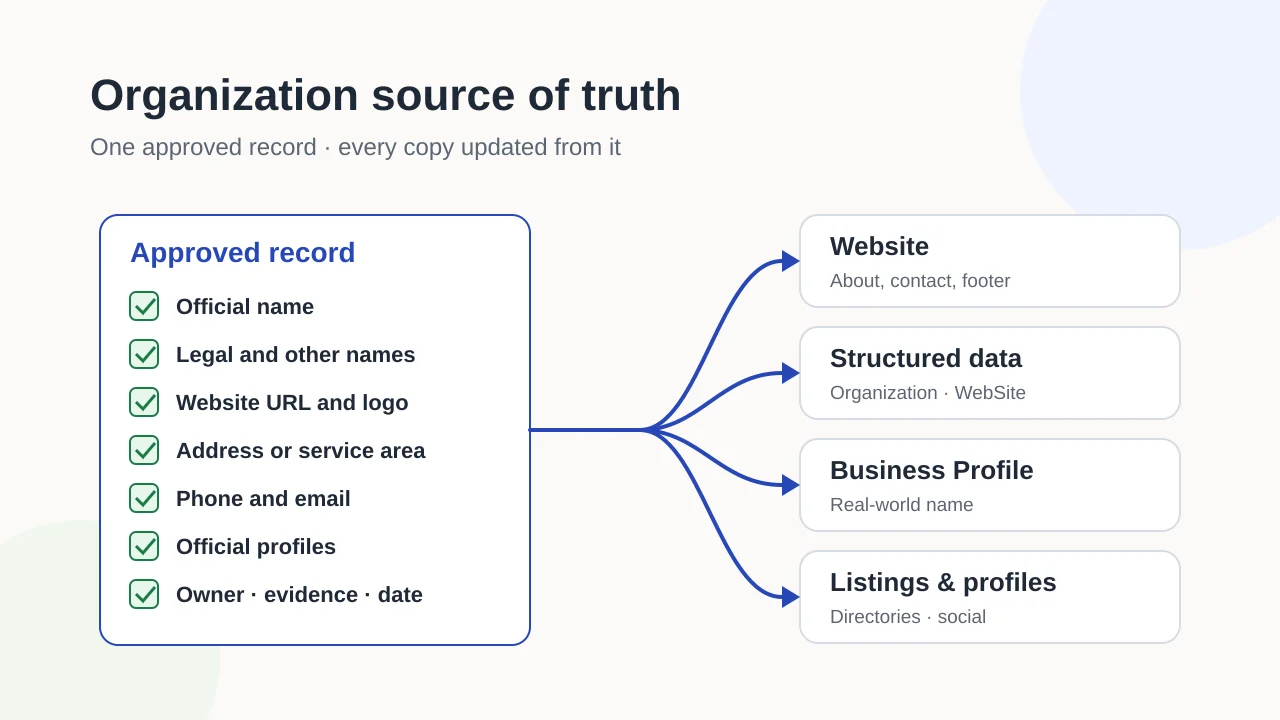
Keep one approved record of your organization's identity details, with an owner and a date, and update every other copy from it.
- 02
Publish the facts on your home page or one page about the organization, and describe only what visitors can see in structured data.
- 03
Consistent details help people and systems check who you are; they do not guarantee a knowledge panel, rich result, ranking or AI citation.
Article tools
Read, review or take this article into your preferred AI assistant.Summarize with AI
Copies a prompt with this article’s canonical URL. Review the result and verify its sources.Clipboard unavailable · copy prompt manually
Your organization’s name, website, address, phone number and official profiles appear in many places: your own site, your structured data, your Google Business Profile, directories and social accounts. Over time those copies drift. A rebrand, a new phone number or an old address left on one listing is enough to make people unsure which details are current.
An organization source of truth is one approved record of those details, with an owner and a date, from which every other copy is updated. This guide shows how to build one and use it. For the wider question of how readers and search systems judge whether information is trustworthy, see our guide to E-E-A-T for AI search.
What the source of truth is and is not
In SEO, an entity is a distinct thing that can be identified, such as a business, a person or a product. Your organization is an entity, and the source of truth is simply the place where your team agrees what is true about it.
It is an internal document, such as a shared sheet or a page in your handbook, not a public page. It records:
- the approved value for each detail;
- the evidence behind it, for example a registration document or the signed-off brand name;
- the owner who may change it;
- the date it was last confirmed.
It does not create recognition by search engines or AI systems on its own. Its job is to stop your own copies from contradicting each other.
Which details to record
Start with the details people use to identify and contact you. The example below uses a fictional company.
| Detail | Example (fictional) | Where it is used |
|---|---|---|
| Official name | Northbay Plumbing | Website header and footer, Business Profile, directories, social profiles |
| Legal name, if different | Northbay Plumbing Services Ltd | Legal and contact pages, invoices, legalName in structured data |
| Other names people use | Northbay | alternateName in structured data; noted so staff use it consistently |
| Primary website URL | https://www.example.com/ | Every profile and listing that has a website field |
| Logo file | One approved file and its URL | Website, structured data, profiles |
| Address or service area | The real customer-facing location or area | Contact page, Business Profile, local listings |
| Main phone and email | The numbers and addresses customers should use | Contact page, profiles, listings |
| Official profiles | Profiles your organization controls | Footer links, sameAs in structured data |
| One-sentence description | What you do and for whom | About page, profile descriptions |
Add a column for evidence and one for last confirmed. If a detail has no evidence yet, mark it as pending instead of guessing.
Publish the facts on one page
Google recommends placing Organization information on your home page, or a single page that describes your organization. Choose one page, make sure the facts in your source of truth are visible there, and link to it from the rest of the site, typically from the footer or an About page.
Keeping the facts visible matters because structured data must describe what visitors can actually see. Google’s general guidelines say not to mark up content that is not visible to readers and that markup must be a true representation of the page.
Use one name everywhere
Pick the official name and use it exactly. Google’s Business Profile guidelines ask that the profile name reflect your real-world business name, as used consistently on your storefront, website and stationery, and they do not allow extra information such as taglines or service descriptions in the name field.
For your website’s name in Google Search, Google uses your home page and references to it across the web, and lets you state a preference with WebSite structured data on the home page. Use the name consistently on the home page, and list genuine alternatives, such as an acronym, in alternateName.
Map the visible facts to Organization structured data
Organization structured data has no required properties. Google recommends adding the properties that are relevant and accurate for your organization. Map each one to a field in your source of truth:
| Structured data property | Source of truth field |
|---|---|
name | Official name |
alternateName | Other names people use |
legalName | Legal name, if different |
url | Primary website URL |
logo | Approved logo file URL |
address | Address, where you publish one |
contactPoint or telephone / email | Main phone and email |
sameAs | Official profiles |
Validate the markup after every change. Valid markup makes eligible features possible, but Google states that structured data does not guarantee that a feature will appear. For implementation details, see our practical guide to schema markup.
Choose sameAs links carefully
Schema.org defines sameAs as the URL of a reference web page that unambiguously indicates the item’s identity, such as an official website or a Wikipedia or Wikidata entry. In practice, list profiles your organization controls or reference pages that are clearly about you. Leave out directory listings you do not manage and pages about a different organization with a similar name.
Keep every copy in sync
When a detail changes, update the source of truth first, then work outward in a fixed order:
- the source of truth itself, with the new value, evidence, owner and date;
- the page that publishes your organization facts, and the site header, footer and contact page;
- the Organization and WebSite structured data;
- your Google Business Profile;
- the directory and citation listings you manage;
- your social and other official profiles.
Record what you changed and when. Our local citation audit checklist shows how to check listings against one approved set of facts and decide which differences need correcting.
What consistency cannot do
Consistent details make it easier for people and systems to confirm who you are. They do not guarantee a knowledge panel, a rich result, a ranking or an AI citation.
Google describes knowledge panels as automatically generated from information that comes from various sources across the web. If a panel about your organization already exists, an official representative can claim it and suggest changes. Your source of truth is then useful evidence for what those changes should be.
Discuss your next step
If you would like help reviewing how your organization is described across your site and structured data, explore on-page SEO services or contact Exendia.
FAQ
Do I need Organization structured data?
It is not required, and Google lists no required properties for it. If you add it, include only accurate properties that match facts visible on the page, and keep it in step with your source of truth.
Which page should hold my organization details?
Google recommends your home page or a single page that describes your organization. Choose one, make the facts visible there and link to it from the rest of the site.
Should every directory listing go in sameAs?
No. sameAs should point to pages that unambiguously identify your organization, such as profiles you control or reference pages clearly about you. Directory listings you do not manage are better tracked in your citation audit.
Will consistent details get my business a knowledge panel?
Not by themselves. Knowledge panels are generated automatically from sources across the web. Consistent, accurate details help people verify who you are, and if a panel exists, an official representative can claim it and suggest corrections.
Evidence layer
References and further reading
Primary documentation used to review the technical concepts in this guide.- Google Search CentralOrganization (Organization) structured data
No properties are required; Google recommends adding relevant ones and placing the markup on the home page or a single page that describes the organization.
- Google Search CentralGeneral structured data guidelines
Markup must represent visible page content; structured data does not guarantee that a feature will appear.
- Google Search CentralSite names in Google Search
- Schema.orgsameAs
- Google Business Profile HelpGuidelines for representing your business on Google
- Knowledge Panel HelpAbout knowledge panels