Read this first
Executive summary
3 operating principles- 01
Treat an AI answer as a dated observation, not a stable ranking.
- 02
Record exact prompts, product context, brand mention and linked source separately.
- 03
Use findings to improve useful pages and verifiable facts; no citation outcome is guaranteed.
Article tools
Read, review or take this article into your preferred AI assistant.Summarize with AI
Copies a prompt with this article’s canonical URL. Review the result and verify its sources.Clipboard unavailable · copy prompt manually
AI search visibility is not a single stable position. Answers can vary by question wording, location, account context, product version and time. A useful assessment therefore records what was observed and how it was checked, rather than turning a handful of screenshots into a claim that a brand “ranks” in every AI answer.
The steps below help a business owner create a small, repeatable baseline and decide what is worth improving. For ongoing support, see Exendia’s GEO and AI visibility service. Work can improve the clarity and discoverability of your information, but no agency can guarantee that an AI system will mention or cite a brand.
Define the questions that matter to buyers
Start with real customer language from sales conversations, support questions, site search or existing keyword research. Group questions by the job a buyer is trying to complete: learning the basics, comparing options, evaluating suppliers or choosing a provider. Avoid generating hundreds of synthetic prompts that do not reflect a decision your business serves.
For each question, note the intended audience, market, product category and expected answer. Keep branded questions separate from category questions. This helps distinguish “Does the tool know our name?” from “Does it surface a useful source when someone asks for a solution like ours?”
Create a small observation set
Choose a manageable set of representative questions and check them consistently across the AI search products relevant to your audience. Record:
- Date and time, product and interface used
- Exact prompt and any follow-up prompt
- Relevant market or location context, if supplied
- Whether the brand is absent, mentioned, recommended or linked as a source
- The exact page URLs cited, when citations are shown
- Which competitors or independent sources appear
- Any caveat, ambiguity or personalization that could affect the answer
Save the complete answer only when it is appropriate to do so and note that another user may receive a different response. A single observation is an example, not a stable share of voice or proof of business impact.
Separate mentions from citations
A plain brand mention, a recommendation and a clickable citation are different observations. A system may name a company without linking to its website. It may cite an industry source that discusses the company without endorsing it. Record those states separately so the analysis does not overstate the evidence.
When a citation is present, open the source and check what it actually says. Is it current? Does it name the business accurately? Is the mention in relevant context? Is it an independent source, the brand’s own site or a directory? This inspection often reveals a practical next step: clarify a page, update a source, or make business facts easier to verify.
Look for a pattern, then choose an action
Review observations by question group. Look for repeated gaps: a missing answer on your own site, inconsistent company details, unclear service boundaries, or a useful third-party source that omits an important fact. Prioritize fixes that improve the experience for people as well as the machine-readable structure of a site.
A practical action list might include:
- Improve a service page so its offer, audience and process are explicit.
- Add a concise, sourced explanation to an existing guide where readers need it.
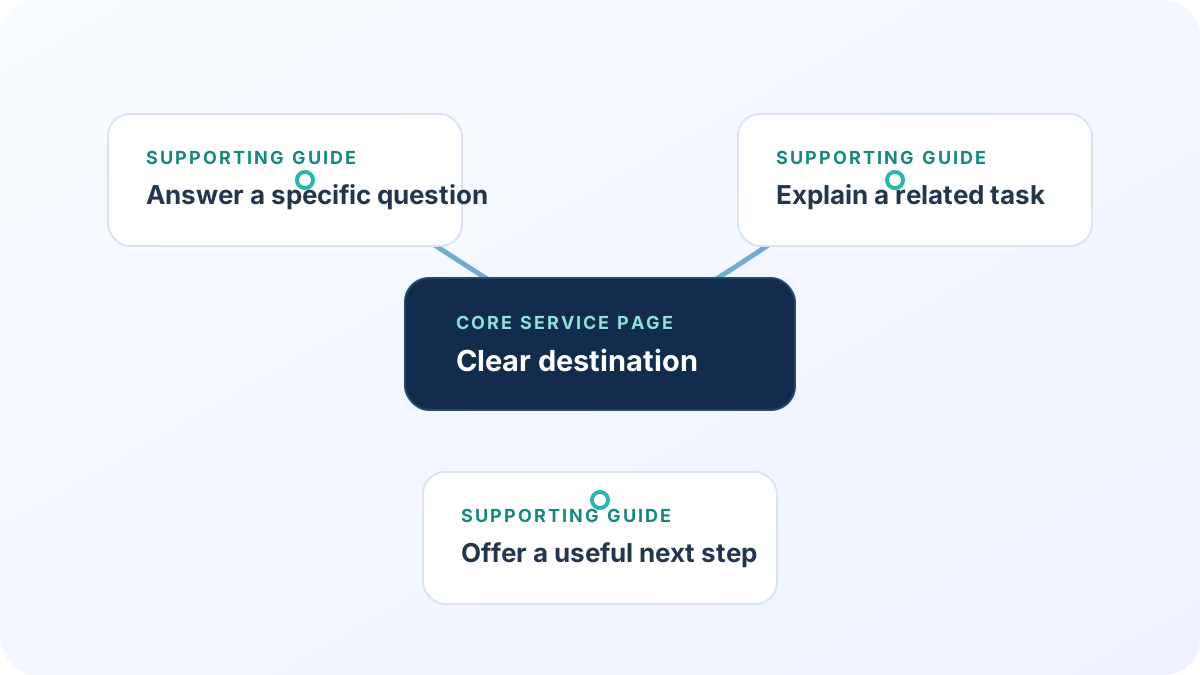
- Make the route between a guide and the relevant service easier to follow. Our internal link architecture guide explains how to do this contextually.
- Correct a demonstrably outdated or inconsistent business fact at its source.
- Recheck the same question set after a meaningful change, keeping the method consistent.
Do not rewrite pages simply to imitate one generated answer. Do not add claims that are unsupported by the business or third-party evidence. Structured data can describe entities and page content, but it does not force inclusion in an AI answer; see our schema and AI visibility guide.
Report limitations clearly
A small prompt set is a sample. Product interfaces and underlying systems can change. Answers may be personalized or generated from sources outside your control. The absence of a citation in one check does not prove that the brand is never cited; a citation in one check does not prove consistent visibility or increased leads.
Report the sample, date, product, prompts, method and source URLs alongside the finding. Keep this observation separate from Search Console data, web analytics and qualified enquiries: each answers a different question. Exendia’s AI visibility work starts with observable findings and practical recommendations, not a guaranteed citation count.
Discuss your next step
Want a second look at your baseline? Explore the AI visibility service or contact Exendia to discuss a focused assessment.
FAQ
Can I measure AI visibility with one score?
A score can summarize a defined tool’s observations, but it is only meaningful when its prompts, sources, time period and calculation are clear. It is not a universal measure of visibility across all AI products.
Does a citation mean that AI recommends my business?
Not necessarily. A citation means a source was linked in that answer. Check the surrounding text to understand whether it supports a fact, provides background or endorses a provider.
How often should I repeat an assessment?
Repeat it after a material site or source change, or at an agreed review interval. Keep the prompts and method stable enough to compare, and note product changes that make comparisons unreliable.
Can GEO guarantee inclusion in AI answers?
No. AI systems choose and generate answers independently. GEO work can improve the quality, clarity and accessibility of information, but cannot guarantee a mention, citation or ranking.
Evidence layer
References and further reading
Primary documentation used to review the technical concepts in this guide.- Google Search CentralAI features and your website
Google states that existing SEO fundamentals apply; eligibility does not guarantee crawling, indexing or appearance.
- Google Search CentralGenerative AI in Search
Official guidance on generative AI features in Search and the continued role of foundational SEO.