Read this first
Executive summary
3 operating principles- 01
Choose the target page and reader before choosing a link tactic.
- 02
Judge the actual publisher, page context, disclosure and destination rather than a single authority metric.
- 03
Track published links separately from rankings, traffic and enquiries; none is guaranteed.
Article tools
Read, review or take this article into your preferred AI assistant.Summarize with AI
Copies a prompt with this article’s canonical URL. Review the result and verify its sources.Clipboard unavailable · copy prompt manually
A link building plan should begin with the pages your business needs to make easier to discover and the audiences those pages serve. The tactic comes second. A relevant editorial mention, a useful expert contribution and a well-maintained niche publication can each play a different role; none is a substitute for useful pages, clear positioning or a credible business.
This guide helps business owners compare common approaches and ask better questions before committing a budget. It does not promise ranking improvements. Search engines evaluate many signals, and a purchased placement or a new link cannot guarantee visibility.
Start with the page and the audience
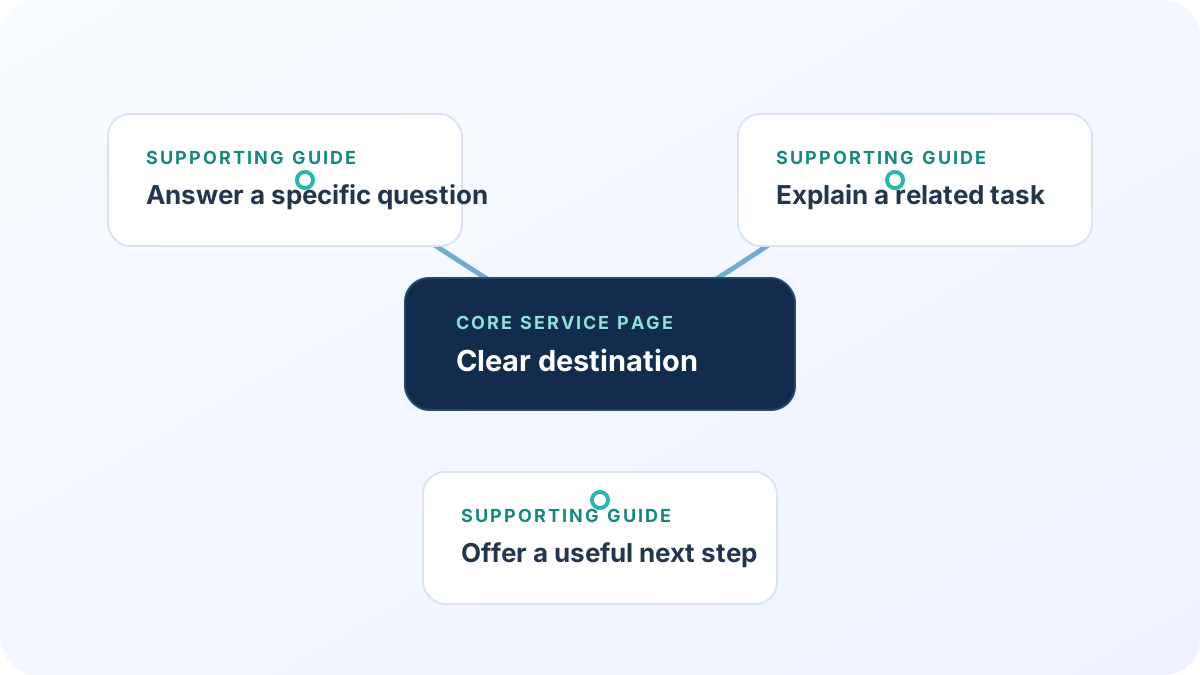
Write down the specific page you want people to find, what it helps them do, and which publications or communities already serve that audience. If the page is not a helpful destination yet, improve it first. A link pointing to an unclear service page is unlikely to resolve the underlying conversion problem.
Then check your internal route to that page. Relevant links from your own guides and service pages help visitors navigate and let crawlers discover important URLs. Our guide to internal link architecture covers how to map those paths without forcing exact-match anchors.
Compare the approaches
| Approach | What it usually involves | Useful when | Questions to ask |
|---|---|---|---|
| Digital PR | Original research, commentary or a story pitched to relevant publishers | You have a distinctive, supportable idea that may interest an audience | Is the claim verifiable? Who owns outreach and follow-up? |
| Expert contribution | A useful article or expert input for a publication | You can offer experience or analysis that fits the publication | Is the contribution editorially independent and clearly attributed? |
| Niche edit | A contextual addition or update to an existing page | The existing page is relevant and the publisher has editorial control | Does the page serve readers? Is the addition disclosed and editorially reviewed? |
| Supplier marketplace | A provider offers access to placements or outreach capacity | You need to compare available inventory and process | How are sites selected, reviewed and reported? What is excluded? |
| Earned mention | A publisher independently references your work or business | Your expertise, product or resource merits coverage | Can you make the resource genuinely useful and easy to verify? |
These labels describe broad workflows, not quality levels. Assess the actual page, publisher, context and editorial policy. A large site metric does not tell you whether a placement is relevant, read by your audience, or appropriate for your business.
Use a quality review before approving work
Review each proposed destination and placement against a short checklist:
- Audience fit: Would a likely reader of that page care about your offer or resource?
- Editorial purpose: Does the link add context or help a reader take a useful next step?
- Page quality: Is the page maintained, understandable and focused on a real audience?
- Disclosure and attributes: Are sponsorship, compensation and link attributes handled honestly and in line with the publisher’s policy?
- Destination quality: Does the linked page answer the need implied by the surrounding text?
- Reporting: Will you receive the actual URL, date, anchor context and any material changes?
- Risk: Does the proposal rely on mass-produced pages, hidden ownership, artificial link networks or guaranteed rankings? If so, pause and investigate.
Google’s spam policies describe links created primarily to manipulate rankings as link spam. That makes transparent editorial control and a defensible reader benefit central parts of a review, not paperwork to complete after a placement is live. A vendor’s domain rating, traffic estimate or “authority” score is a third-party metric, not a guarantee of search performance.
Plan the work before contacting a provider
Set a baseline for the page, the query group you care about and the current internal links. Agree on the page types and sources that are acceptable, the review and approval steps, what counts as a completed deliverable, and how changes or removals will be handled. Keep outreach and publishing records so your team can check every URL later.
For a practical preparation checklist, see what to prepare before a link-building campaign. Exendia’s link building service can be discussed when you have a target page and a clear scope; an enquiry is a conversation about fit, not a promise of rankings.
Measure what you can actually observe
Record delivered URLs and verify that the pages load, the links point to the intended destination, and any disclosure is present. Then monitor relevant search queries and conversions over time. Search Console impressions, clicks and average position describe observed search performance; they do not isolate the causal effect of one link. Keep delivery verification separate from business outcomes.
Discuss your next step
Need help scoping a campaign? Review Exendia’s link building service or contact the team to discuss your target pages and review criteria.
FAQ
Is one link-building method best for every business?
No. The right approach depends on the audience, page, editorial opportunity, budget and risk tolerance. Compare specific placements and processes instead of choosing by tactic name alone.
Can a link-building provider guarantee rankings?
A provider cannot control search systems or guarantee a ranking outcome. Treat ranking guarantees as a warning sign and ask instead for transparent scope, URLs, review criteria and reporting.
Should every link use the target keyword as its anchor?
No. Anchor text should make sense in its sentence and accurately describe the destination. Repeating exact-match commercial anchors can look unnatural and does not guarantee better performance.
What should I prepare before a campaign?
Define the page and audience, share accurate business information, document acceptable publishers and exclusions, and agree on review, reporting and change-handling steps. The campaign preparation checklist expands on these inputs.
Evidence layer
References and further reading
Primary documentation used to review the technical concepts in this guide.- Google Search CentralSpam policies for Google web search
Google’s definitions and examples of link spam inform the risk review; assess each placement in context.