Read this first
Executive summary
3 operating principles- 01
GEO and SEO share useful foundations such as accessible, helpful pages and clear evidence.
- 02
AI answer mentions, linked citations, crawl access and search rankings are different observations.
- 03
Use product-specific evidence and realistic measures; no single optimization guarantees an AI citation.
Article tools
Read, review or take this article into your preferred AI assistant.Summarize with AI
Copies a prompt with this article’s canonical URL. Review the result and verify its sources.Clipboard unavailable · copy prompt manually
The short answer
SEO is the established practice of making a site accessible, understandable and useful for searchers. GEO (“generative engine optimization”) is a practitioner term for work intended to improve how content is discovered or represented in AI-generated answers. It is not a universal technical standard, and providers do not publish a shared ranking formula for citations.
For Google AI Overviews and AI Mode, Google says the same Search fundamentals apply: pages must be indexed and eligible to appear with a snippet; no special AI markup is required. Other services have different systems. This comparison explains the practical overlap without treating GEO as a replacement for SEO.
For a repeatable observation method, see how to assess AI search visibility, including how to distinguish a visible mention from a linked citation.
SEO and GEO at a glance
| Question | Traditional SEO work | GEO or AI-search work |
|---|---|---|
| What is observed? | Search impressions, clicks, indexing and result appearance in available tools | Visible answers, linked sources and brand mentions in a defined set of AI products and prompts |
| What can a site owner control? | Crawl access, page quality, technical structure, internal links and accurate metadata | The same site foundations, plus a disciplined way to inspect and record product-specific source behavior |
| What is not guaranteed? | Crawling, indexing, ranking or traffic | Retrieval, a brand mention, a citation or a stable answer |
| What is documented? | Search requirements and guidance from each search provider | Provider-specific crawler and search behavior; no shared citation optimization formula |
The labels describe different ways people may encounter information, but the work overlaps. A technically sound, helpful page supports ordinary search and can also be available to systems that retrieve web content.
What changes in an AI answer
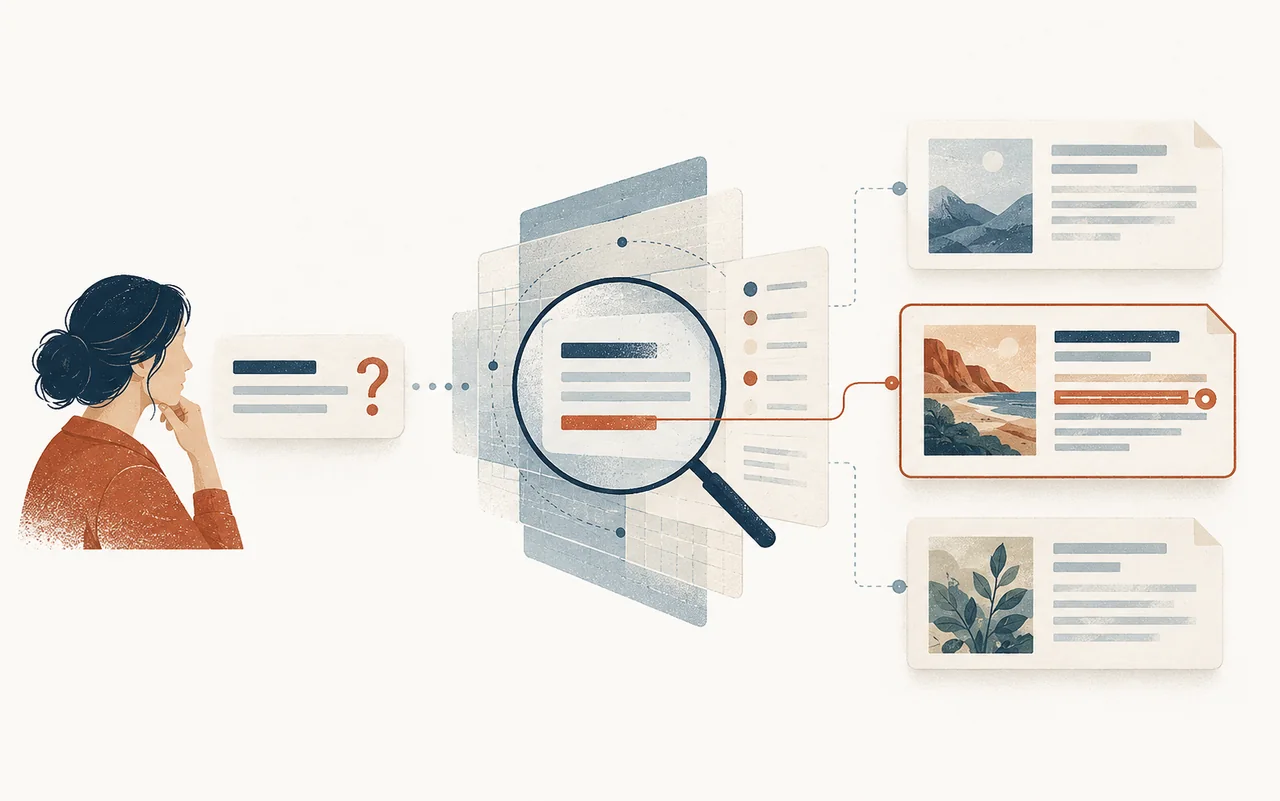
A conventional results page exposes a set of links. An answer product may synthesize text, show source links, omit sources, or use a mode that does not browse the live web. For example, OpenAI documents a specific crawler for ChatGPT Search and a separate crawler related to potential model training. A brand name in generated text is therefore not the same evidence as a clickable citation to a page.
A useful measurement record separates:
- Citation: the response visibly links to a specific URL.
- Mention: the response names a brand or source without linking to it.
- Access: a provider’s crawler is permitted or observed fetching a page.
- Outcome: ranking, visibility or a business result, which requires its own measurement.
Do not infer that training inclusion caused a particular answer, or that a citation will persist across prompts and dates.
A practical approach for both
- Keep the technical foundation sound. Allow intended crawlers, provide important content in text, use working canonical URLs and link important pages from relevant parts of the site.
- Answer a defined reader need. Put a clear answer near the start, explain terms, cite primary evidence for factual claims and make limitations visible.
- Use structured data for its documented purpose. It should match visible content and comply with search-feature guidance. Google says there is no special schema requirement for AI Overviews or AI Mode.
- Strengthen the site’s information paths. Add internal links where the reader benefits from a next step. This helps navigation and discovery; it is not a promise of citations.
- Measure channels separately. Use Search Console for Google Search data when available. For AI citations, use a stable prompt sample, preserve the product and mode, save exact URLs and repeat observations over time.
For a detailed evidence log, continue to how to inspect AI-search citations. For the larger Exendia framework, see LEO; that pillar describes an operating model, while this page focuses on the terminology and overlap between GEO and SEO.
For help applying these foundations to your site, review Exendia’s GEO and AI visibility services. The service page describes the work and its measurement limits; it does not promise citations or rankings.
FAQ
Is GEO the same as SEO?
No. GEO is a newer practitioner term for work related to discovery and representation in generative answers. It overlaps with SEO fundamentals, but there is no single agreed standard or provider-independent method.
Does ranking in Google guarantee a ChatGPT or Perplexity citation?
No. Ranking and visible citations are different observations. A result in one system does not guarantee inclusion in another product’s answer.
Is special schema required for AI Overviews?
No. Google says there is no special schema.org structured data required for AI Overviews or AI Mode. Accurate, policy-compliant markup remains useful for supported Search features.
How should GEO performance be measured?
Record a repeatable set of prompts and product modes, then log mentions and exact linked source URLs with dates. Treat results as observations for that sample rather than a universal ranking.
Evidence layer
References and further reading
Primary documentation used to review the technical concepts in this guide.- Google Search CentralAI features and your website
Google documents that its AI features use existing Search fundamentals and require pages to be indexed and snippet-eligible. Accessed 18 October 2026.
- OpenAIOverview of OpenAI Crawlers
Documents separate crawlers and purposes for ChatGPT Search and model training. Accessed 18 October 2026.